Start with the phrase “not capable of being naturally produced,” the federal test for which cannabinoids still count as hemp after the 2026 change to the hemp definition. It covers cannabinoids the cannabis plant cannot make on its own. Public Law 119-103, Section 2019 limits the November 12, 2026 start to that group only, and cannabinoids the plant can produce but that were made outside it, plus the THC caps, follow on December 11, 2026. Products excluded from hemp are treated as marijuana under the Controlled Substances Act as of the effective date. Which compounds land in which group depends on FDA lists that Marijuana Moment reported on November 9, 2026 were still unpublished.
Disclosure: Heads up, some links on this page are affiliate links. When you purchase through them, we may be paid a commission.
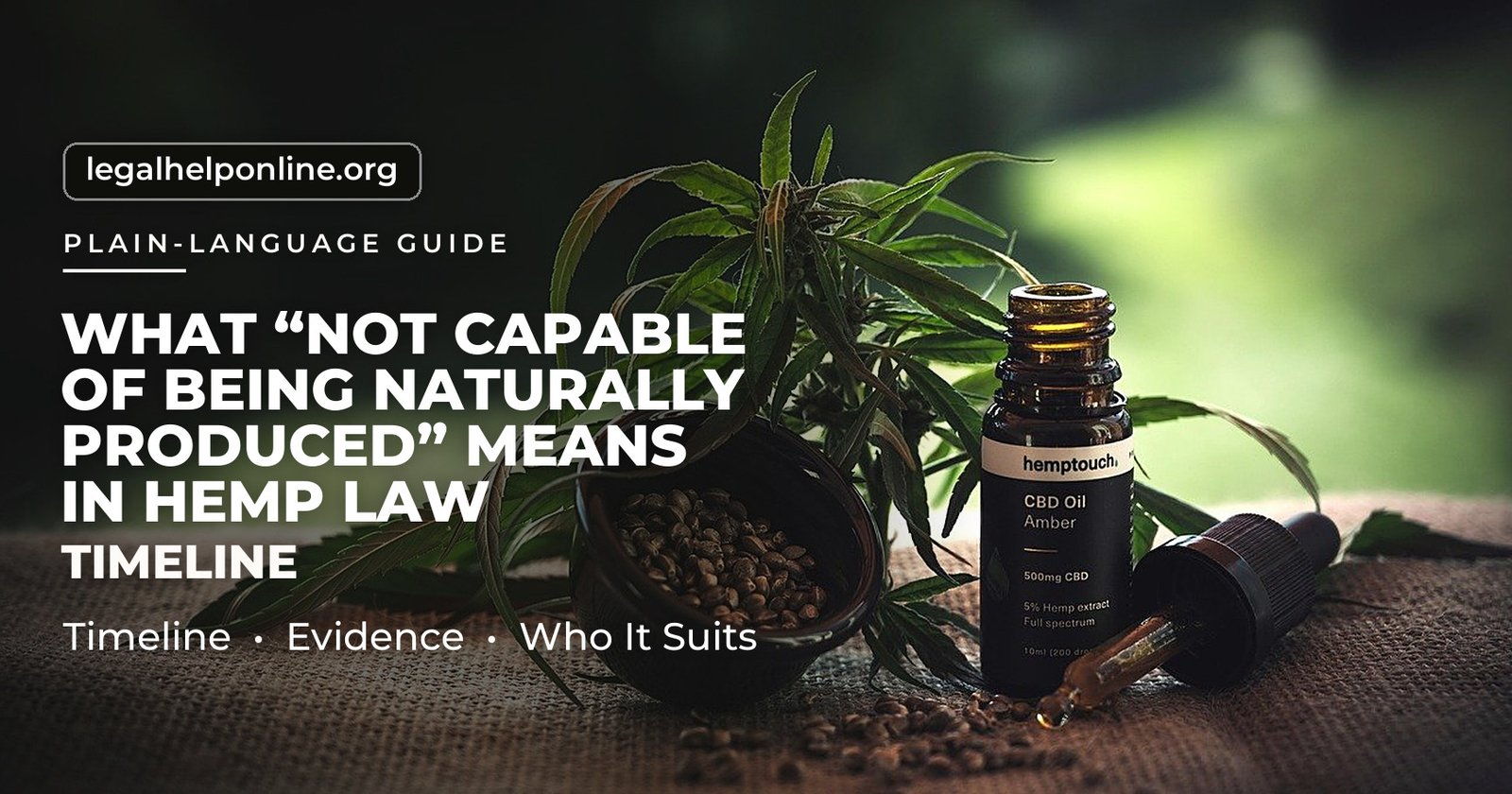
What does “not capable of being naturally produced” mean in hemp law?
The phrase comes from the federal change to the hemp definition in P.L. 119-37, Section 781, which amends 7 U.S.C. 1639o. The exclusion for final products covers products containing cannabinoids that are “not capable of being naturally produced by a Cannabis sativa L. plant.” Intermediate products get a parallel clause with the same wording.
A second group sits beside it: cannabinoids the plant can make, but that were “synthesized or manufactured outside the plant.” The first test asks whether the plant can make the compound at all. The second asks where this particular compound was made.
| Phrase in the statute | What it means in plain terms | When it takes effect |
|---|---|---|
| “not capable of being naturally produced by a Cannabis sativa L. plant” | The plant cannot make this cannabinoid on its own | November 12, 2026, under P.L. 119-103, Section 2019 |
| “capable of being naturally produced” but “synthesized or manufactured outside the plant” | The plant can make this cannabinoid, but this one was made outside the plant | December 11, 2026 |
Quick facts on the hemp definition, as of November 11, 2026
| Item | What the text says | Source |
|---|---|---|
| Statute | Section 781 of Division B changed the hemp definition at 7 U.S.C. 1639o and was enacted November 12, 2025 | P.L. 119-37, Section 781 |
| November 12, 2026 group | Intermediate and final products with cannabinoids the plant cannot naturally produce fall outside hemp and are classified as marijuana under the Controlled Substances Act | Congressional Research Service IF13136 |
| December 11, 2026 items | The 0.3 percent total THC test including THCA, the converted and synthesized exclusion, the 0.3 percent intermediate cap, the 0.4 milligram per container cap, and the viable seed limit | P.L. 119-103, Section 2019 |
| Delay law | Passed September 2, 2026; Section 2019 limits the section 781 amendments to the November 12 group until December 11, 2026 | P.L. 119-103 |
| FDA lists | Three lists and container information were due by February 10, 2026; not published as of November 9, 2026 | Marijuana Moment, November 9, 2026 |
| Controlling text | The statute controls when outlets describe the dates differently | P.L. 119-37, Section 781 |
What changes on November 12, 2026?
Starting November 12, 2026, the group of cannabinoids the plant cannot naturally produce drops out of the hemp definition. P.L. 119-103, Section 2019 holds the rest of the section 781 changes back until December 11, 2026, and during that window the amendments reach only the two clauses covering cannabinoids the plant cannot make. The Congressional Research Service says products in that group are classified as marijuana under the Controlled Substances Act.
Cogent Law’s November 12 and December 11 summary uses THC-O as its example of a cannabinoid the plant does not naturally produce.
What waits until December 11, 2026?
Everything else in the new definition waits until December 11, 2026. From that date, the following apply:
- Cannabinoids the plant can naturally produce, but that were made outside the plant
- A total THC limit of 0.3 percent on a dry weight basis, counting THCA
- A 0.3 percent cap on combined total THC and similar-effect cannabinoids in intermediate products
- A 0.4 milligram cap on combined total THC and similar-effect cannabinoids per container for final products
- A limit on viable seeds from plants above 0.3 percent total THC
Cogent Law adds that December 11 is also when the stopgap government funding in P.L. 119-103 expires.
Why do outlets disagree about November 12 and delta-8?
Headlines and retailer posts do not agree on which products the November 12 date reaches. Several examples:
- ABC11 and some retailer posts say converted delta-8 and HHC lose hemp status on November 12.
- Harris Sliwoski’s November 11, 2026 note ties the November 12 date to synthetic and converted cannabinoids, while also saying cannabinoids made outside the plant are excluded.
- cannabisregulations.ai says the November 12 language covers THC-O and possibly HHC, and places the converted delta-8 and delta-10 exclusion on December 11, 2026.
- Houston Public Media describes December 11 as the federal ban date for products including delta-8 and delta-10.
- OFW Law’s federal hemp ban article, dated November 5, 2026, reads the dates the way the statute does: only the November 12 exclusion keeps its original date, while December 11 also reaches naturally occurring cannabinoids made outside the plant and intermediate products sold to consumers.
The statute is the controlling text. Cogent Law says delta-8 does occur naturally, so delta-8 products are not swept into the November 12 exclusion on that basis alone, and their bigger exposure comes on December 11, under the converted-cannabinoid exclusion and the new THC caps.
Common mix-ups
| Mix-up | What the text and sources say |
|---|---|
| All THC-type cannabinoids fall under the same date | They do not. THC-O is the example Cogent Law gives of a cannabinoid the plant does not naturally produce, and it sits in the November 12 group. A February 13, 2023 DEA letter to Rod Kight said delta-9-THC-O and delta-8-THC-O “do not occur naturally in the cannabis plant.” Cogent Law reads delta-8 as occurring naturally, so it would not fall in the November 12 group on that basis alone, but OFW Law says the question is not settled because FDA’s list has not been published. |
| HHC is covered by the November 12 rule | HHC has a separate DEA track. The DEA hexahydrocannabinol final rule, published May 4, 2026, lists HHC in schedule I, and the DEA says the listing “will not alter the status of this substance.” |
| Hemp beverages and the 0.4 milligram cap start November 12 | Under the statute text, the container cap is a December 11 item, and Cogent Law places it there too. OFW Law says December 11 covers intermediate products sold to consumers. |
| A retailer post with a November 12 cutoff reflects the law | One retailer’s Facebook post says federal law reverts synthetic-type cannabinoids such as D8, THCP, HHC and CBC on November 12, and that hemp beverages become federally illegal after that date. Check any post like this against the statute, and remember that the November 12 group depends on FDA’s unpublished list. |
Does hemp have psychoactive properties?
The hemp definition is built around THC, and CRS explains where the line sits. Delta-9 THC is the main psychoactive compound in cannabis, while other THC-type compounds can also be present. Other cannabinoids, such as CBD, are generally not considered psychoactive. CRS also notes that delta-9 is not the only THC in the plant that can intoxicate, with delta-8 as an example, which is why the new definition counts total THC rather than delta-9 alone.
What was FDA supposed to publish?
The statute gave FDA 90 days from enactment, to February 10, 2026, to publish four items: a roster of cannabinoids the plant can naturally make, a roster of THC-class cannabinoids found naturally in the plant, a roster of other compounds with similar effects, and more detail on the term “container.” CRS reported on September 28, 2026 that none had been published, and Marijuana Moment reported on November 9, 2026 that FDA still had not published them.
Who does this affect?
Cogent Law says manufacturers, retailers, growers and their banks are all watching both dates. Manufacturers and processors face the November 12 date for THC-O and other cannabinoids the plant does not naturally produce. Giesler Law’s hemp restrictions article says industrial hemp grown for fiber, grain, seed, textiles and building materials generally remains unaffected by the new restrictions.
State rules can differ. Giesler Law reports that Oklahoma’s regulator, ODAFF, named delta-8 THC and similar isomer products as examples that will no longer qualify as hemp after November 12, 2026. Illinois has its own hemp law restrictions starting November 12, 2026. According to the Chicago Tribune (November 10, 2026), Illinois agreed to hold off enforcing against businesses in the federal lawsuit and their association’s members until a November 19, 2026 hearing. The Illinois Hemp Act lawsuit page covers that timeline. In California, Harris Sliwoski (November 11, 2026) says AB 8 already limits hemp product sales. If you are in Texas, our Texas hemp rules lawsuit guide covers the state side.
Who should you ask, and what should you check?
Take questions about your own product or situation to an attorney. For state rules, ask your state hemp or cannabis regulator; in Oklahoma, that is ODAFF.
These questions settle most next steps:
- Which cannabinoids are in the product, including minor and converted ones?
- Is any cannabinoid one the plant cannot naturally produce, and is it in an intermediate or final product?
- Was any cannabinoid the plant can produce made outside the plant?
- What is the total THC per container, and does the lab report measure total THC including THCA?
- Which state are you in, and what has its regulator said about these dates?
- Has FDA published its cannabinoid lists yet?
By LegalHelpOnline.org Legal Research & Editorial Team